


Table of Contents
Frontier AI is changing cyber risk in a fairly specific way. It is making some technical work faster, cheaper and easier to repeat. That includes finding vulnerabilities, testing combinations of weaknesses, writing exploit code and automating parts of an intrusion. For Australian companies, the consequence is a shorter window between a weakness becoming visible and someone trying to use it.
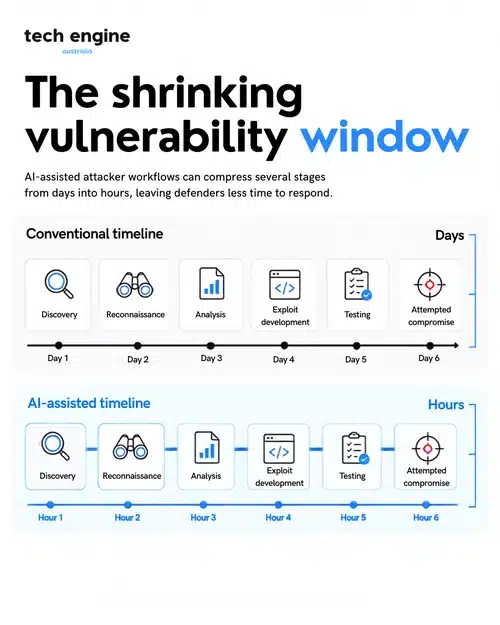
On Aug. 5, the Australian Signals Directorate, working with the Australian Institute of Company Directors, issued guidance for boards on the issue. It said frontier models can identify vulnerabilities and rapidly weaponise them, combine several low-severity weaknesses into a high-impact compromise, and carry out malicious activity with little human oversight. The guidance says vulnerability discovery and exploitation could move from days to hours.
That does not mean every cybercriminal now has an autonomous system capable of breaking into a well-defended company. It does mean that some of the work that once absorbed an attacker’s time can increasingly be handed to software.
The change is speed, not magic
Most successful attacks still depend on ordinary weaknesses: software that has not been patched, credentials that have been stolen, an account with excessive privileges, a public-facing service nobody is watching, or a supplier whose access has not been reviewed.
Frontier AI makes those weaknesses easier to search for at scale. A model can examine code, configurations and technical documentation quickly. An agent can be given a task, use tools, inspect the result and continue. The important shift is the amount of searching, testing and analysis that can be done before a person needs to intervene.
For a company with a large technology estate, that puts more pressure on patching. A critical update that sits in a normal maintenance queue for a week may be exposed to far more automated scrutiny during that week. Old internet-facing systems and forgotten accounts carry the same problem.
Small weaknesses can add up
Security teams often assess vulnerabilities one by one. That is useful for triage, but it can hide the route through a system. An outdated application may be judged low risk, a permissive service account may attract little attention, and a network segment may be broader than it needs to be. Combined, those conditions can give an attacker a path that none of them created alone.
Businesses should know which systems are exposed to the internet, which identities have privileged access, where legacy technology remains in use and how far an attacker could travel after compromising one account or device.
Good cyber security services should provide visibility across that chain, not simply add another security product to it. The Essential Eight remains relevant because patching, access control and recovery become more valuable as AI-enabled cyber attacks increase the pace of testing and discovery.
What boards need from the IT team
Boards do not need a technical briefing on every new AI model. They do need a few answers that can be expressed plainly.
How long does it take to identify a critical vulnerability on an internet-facing system? Who can authorise an emergency patch outside the normal maintenance schedule? Which privileged accounts would cause the most damage if compromised? Are unused accounts removed? Can the business restore its most important systems from backup, and has that process been tested recently?
There is also the question of detection. If an intrusion developed over several hours instead of several days, would the organisation notice soon enough to contain it? A security program can look complete on paper and still move too slowly when approvals, technical work and business decisions have to happen under pressure.
What businesses should review now
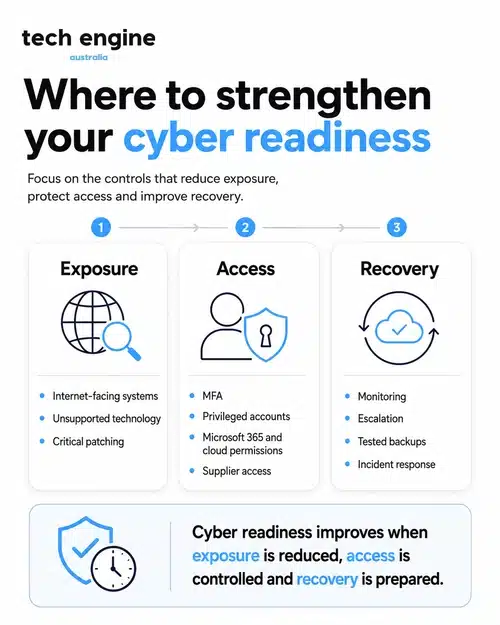
For most organisations, the immediate priority is not to introduce a separate “AI security” program. It is to make sure the controls already in place can respond quickly enough when a serious vulnerability or suspicious activity appears. That starts with knowing which systems are exposed to the internet, keeping unsupported technology out of critical environments, tightening privileged access and making sure multi-factor authentication is applied where it matters most.
It is also worth looking at how quickly the organisation can act when something urgent happens. Critical patches should not be held up by a process designed for routine maintenance, and access to Microsoft 365, cloud platforms and business applications should be reviewed regularly rather than only after an incident. For businesses using managed IT services, this is a good time to understand how urgent vulnerabilities, after-hours incidents and escalation are handled.
The same applies to recovery. Backups should be tested, supplier access should be reviewed, and teams should know what they would do if an attacker moved through the environment faster than expected. The aim is not to prepare for a hypothetical form of cyber attack. It is to reduce the number of weaknesses an attacker can use and shorten the time it takes to detect, contain and recover from an incident.
What to do with the warning
Australian businesses do not need to rebuild their security programs around speculative technology. They do need to examine where routine processes have become slow, where old systems remain exposed and where access has accumulated without enough review.
Tech Engine helps businesses strengthen those areas through managed security, monitoring, identity and access management, infrastructure management and incident readiness. If you are reviewing cyber security in Brisbane or IT support in Brisbane, we can assess the environment you have now, identify the gaps that deserve attention first and build an improvement plan around the way your business operates.